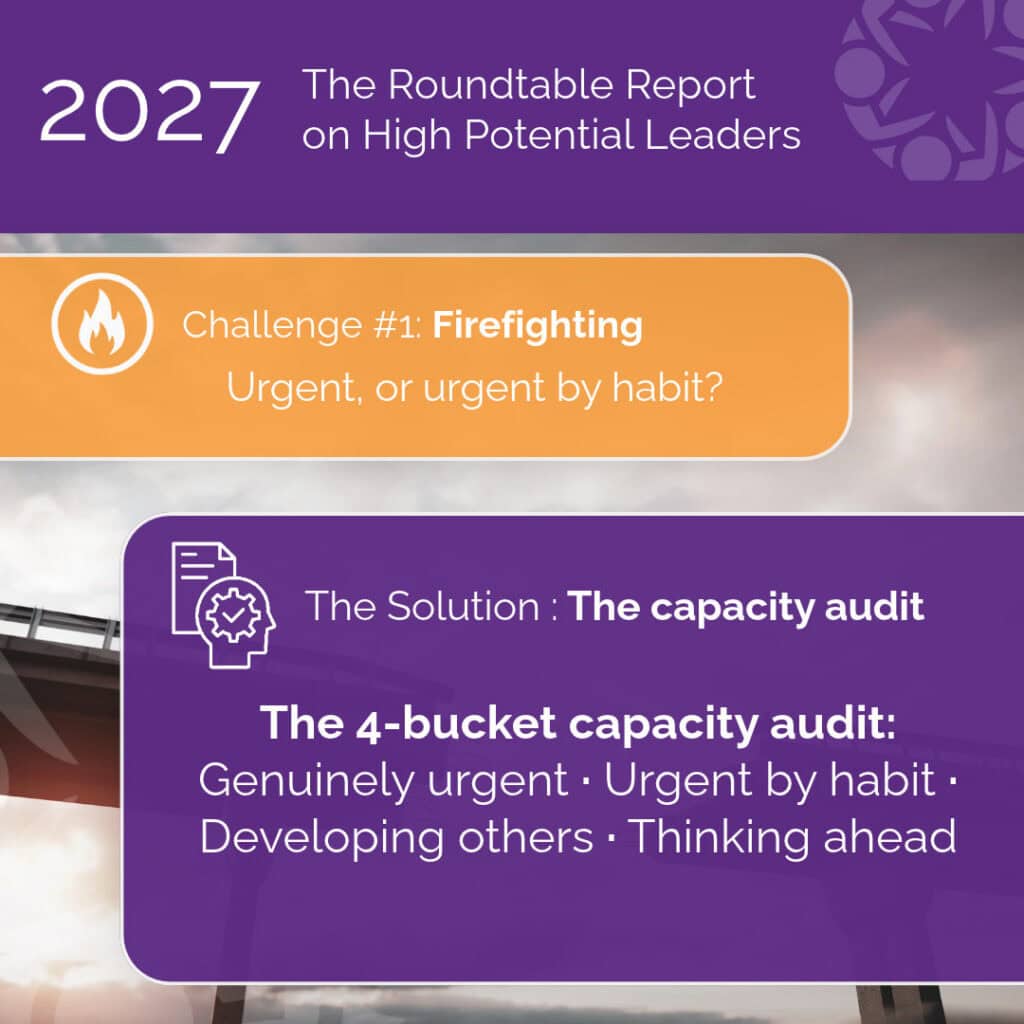
Last week I shared the number that stopped us in our tracks this year. 69% of high potential leaders now name constant firefighting as a top-five challenge, up from 45% in 2026.
The obvious response is to tell leaders to protect their time. It doesn’t work. You can’t ask someone to hold a boundary the organization keeps redrawing. Firefighting at this scale isn’t a personal time-management problem. It’s a system problem, and it needs a system fix.
The good news is that the fix doesn’t start with a new program. It starts with looking.
Step one: find out where the time actually goes
Most organizations have never mapped what their high potential leaders spend their days on. So start there with a simple capacity audit.
Choose three to five high potentials across different functions. Ask each of them to look back over two typical weeks and sort their time into four buckets:
- Genuinely urgent. Things that truly couldn’t have waited.
- Urgent by habit. Things treated as urgent because that’s how the culture works: the same-day turnaround nobody needed, the meeting that exists because it always has.
- Developing others. Coaching, mentoring and building their team.
- Thinking ahead. Planning, strategy, solving the problem before it becomes a fire.
Then ask one more question: what in bucket two could be eliminated, automated or handed to someone else?
The conversation is as valuable as the data. Expect leaders to find the first two buckets hard to separate. That’s the point. When everything feels urgent, nothing gets examined.
Step two: look for the pattern, not the person
Once you have a few audits, look across them. Are the same sources of fire showing up again and again? A recurring approval bottleneck? Executive requests that arrive without context? A reporting cycle that consumes days?
Those patterns are where your leverage lives. Fixing one root cause can return hours to every leader it touches. Telling individuals to work smarter returns nothing.
Step three: make it someone’s job to ask “why is this a fire?”
Many organizations have habits that keep firefighting going. Late decisions push urgency downstream. Unclear priorities mean everything gets treated as priority one.
After a capacity audit, give someone the job of tracing the biggest recurring fires back to their source. Often the fix is a decision made earlier, or made once instead of three times.
Why this is worth the effort
When I talk about drift, I’m describing committed, capable leaders slowly heading somewhere other than where they started. Firefighting accelerates that drift because it replaces the work that gives them direction with work that goes in circles.
Give them back even a few hours of challenge that moves, and you change the direction. That costs less than a replacement hire, and far less than losing a leader with seven years of institutional knowledge.
Try this before year-end
Run one capacity audit with one high potential leader before the holidays. Thirty minutes, two weeks of calendar, four buckets. You’ll learn more about your organization’s operating model than any engagement survey will tell you.
Next week, we turn to something harder to see than a full calendar: what your best leaders aren’t telling you.
Download this year’s The Roundtable Report on High Potential Leaders for the full findings.